China has a way of turning “high-tech, heavily regulated” healthcare products into commodity pricing. I wrote about that dynamic in vaccines—where a flu shot can end up cheaper than milk tea—in my earlier post.
GLP‑1 drugs are a global frenzy for obvious reasons: chronic disease, a huge weight‑management market, and a class of therapies that actually works. In China, Frost & Sullivan is cited as forecasting the weight‑loss drug market growing to RMB 8.7B in 2025 and RMB 14.9B in 2030: https://www.jiemian.com/article/13796438.html
But China is rarely a simple “copy the US pricing curve” market. The question I keep hearing—especially around semaglutide—is more specific:
If semaglutide’s China patent cliff is close, does it become the next “price‑war product”?
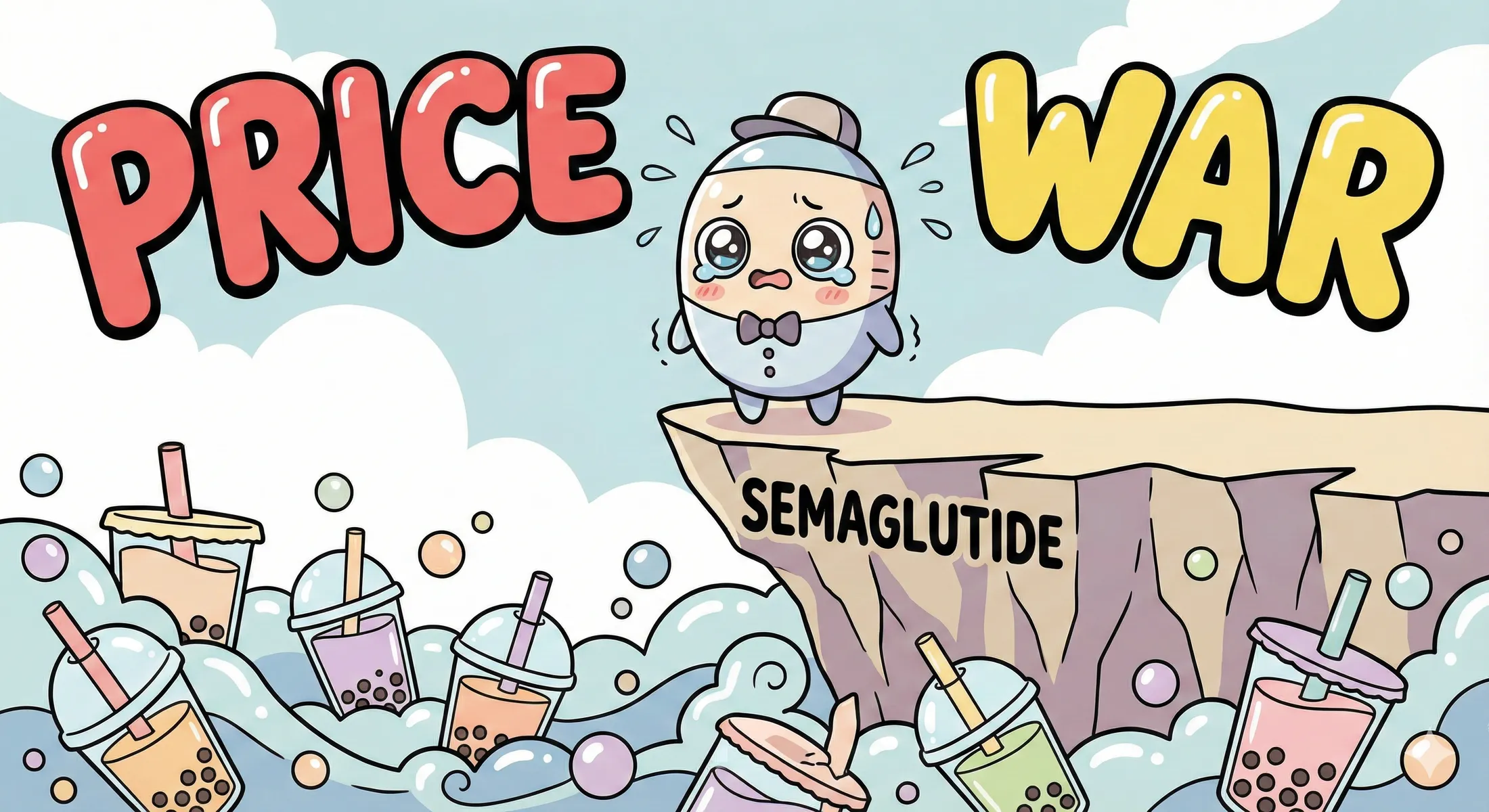
This is a pricing‑mechanics post, not medical advice.
The patent clock is real—and the queue is unusually crowded
In Chinese reporting, semaglutide’s key China patent milestone is consistently described as landing in March 2026 (for the core patent sequence / compound protection window). For example, a Southcn/NFNews report explicitly frames March 2026 as the moment when domestic challengers will intensify their push: https://www.nfnews.com/content/46NBxb2M6m.html
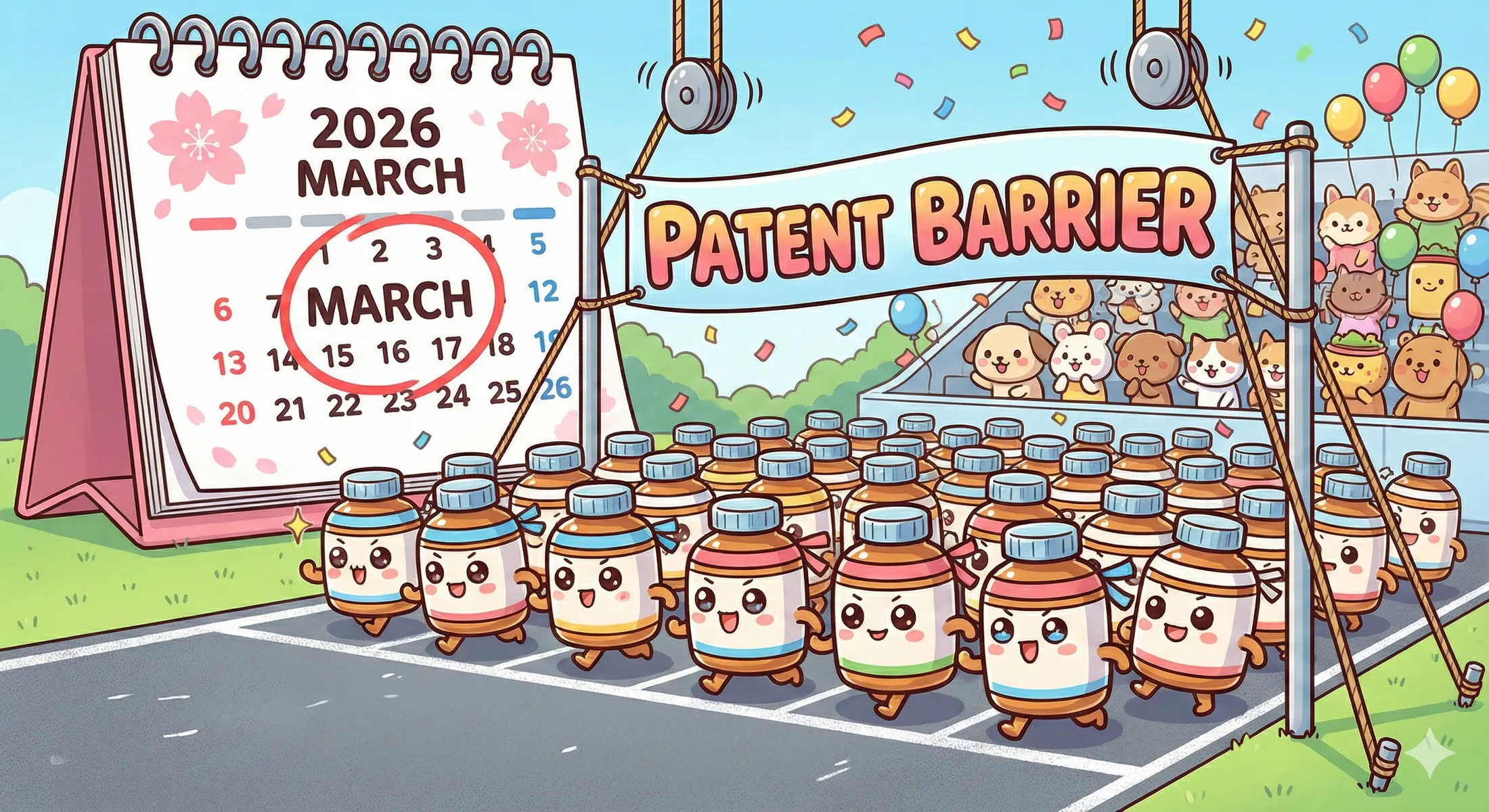
One patent number comes up repeatedly in local discussions: ZL 200680006674.6 (often written as CN200680006674.6). One English-language IP analysis (written in the context of China’s invalidation proceedings) describes it as the “fundamental” semaglutide patent in China and places its expiry at March 20, 2026: https://chinapatentstrategy.com/beijing-ip-court-reverses-cnipas-decision-accepting-novo-nordisks-post-filing-data-upholding-the-ozempic-semaglutide-patent-in-china-as-valid/
And this queue is not theoretical.
On the “already filing” side, NFNews lists named entrants whose semaglutide injection applications were accepted (and who, in practice, are racing for the same hospital channels): Jiuyuan Gene (九源基因), Livzon (丽珠集团), Qilu Pharma (齐鲁制药), and The United Laboratories (联邦制药), among others: https://www.nfnews.com/content/46NBxb2M6m.html
On the “clinical-stage pack behind them” side, the same report mentions more than 20 domestic semaglutide candidates in clinical development, including Sihuan Pharma (四环医药), CSPC (石药集团), Chia Tai Tianqing (正大天晴), and Chen’an Bio (宸安生物): https://www.nfnews.com/content/46NBxb2M6m.html
Even by China standards, that is dense for a biologic. Once the first few approvals land, pricing expectations tend to reset quickly—because procurement systems reward interchangeability, not brand history.
How low can semaglutide go? Start with a cost floor
The counterintuitive part of GLP‑1 pricing is that the peptide API can be extremely expensive per kilogram, yet surprisingly cheap per dose—because the dose is tiny.
Jiemian quotes spot semaglutide API around $545k/kg (roughly RMB ~4.0m/kg): https://www.jiemian.com/article/13011007.html
Back‑of‑the‑envelope math (using 2.4 mg as the weight‑management maintenance dose):
~RMB 3.9–4.0m / kg
= ~RMB 3.9–4.0 / mg
× 2.4 mg ≈ RMB 9–10 per injection
So the raw molecule itself is not the “this can never get cheap” barrier. The real floor is everything around it.
The biggest physical floor is the device. A Huafu Securities note (PDF) cites an “overseas research” estimate where Ozempic’s active drug production cost can be as low as ~$0.30 per 1 mg, while a single injection pen costs about ~$2.83 to produce (and more under OEM): https://pdf.dfcfw.com/pdf/H3_AP202409171639900562_1.pdf

The same note also makes two points that matter for a China price‑war forecast:
- The pen business is not a random accessory; it is a supply chain with real capacity constraints. Novo Nordisk disclosed producing 800+ million pens per year, and still expanded pen capacity (including a China Tianjin investment and a France expansion).
- Injection pens are protected by deep IP and manufacturing know‑how (it cites 1500+ core pen patents, with most already held by incumbents; Ypsomed is highlighted as a key OEM player).
In other words: even if semaglutide API gets commoditised, “cheaper than milk tea” is not the base case. But “hundreds of yuan forever” is also not defensible.
Where the pressure comes from anyway: VBP + better next‑gen drugs
The first source of pressure is institutional: once multiple products are “similar enough,” China tends to turn price into a gatekeeper.
Insulin is the closest precedent. NHSA’s own write‑up of the insulin procurement round describes an average 48% price cut, with examples like glargine dropping from RMB 140–160 per pen to around RMB 70, and second‑generation insulin broadly moving from around RMB 50 to under RMB 30: https://www.nhsa.gov.cn/art/2024/4/17/art_14_12404.html
Semaglutide is not insulin—device formats and clinical usage differ—but the procurement logic rhymes. If semaglutide ends up with multiple domestic biosimilars in broad hospital channels, it is hard to imagine it staying outside “price for volume” gravity for long.
The second source of pressure is market‑driven: when better drugs arrive, the previous generation survives by becoming the “good enough” option—and “good enough” is defended with price.
Jiemian’s overview of the “weight‑loss drug wave” frames tirzepatide and semaglutide as the global “two giants,” and highlights domestic next‑gen entrants such as Innovent’s mazdutide (a dual agonist) moving quickly through China’s pipeline: https://www.jiemian.com/article/13796438.html
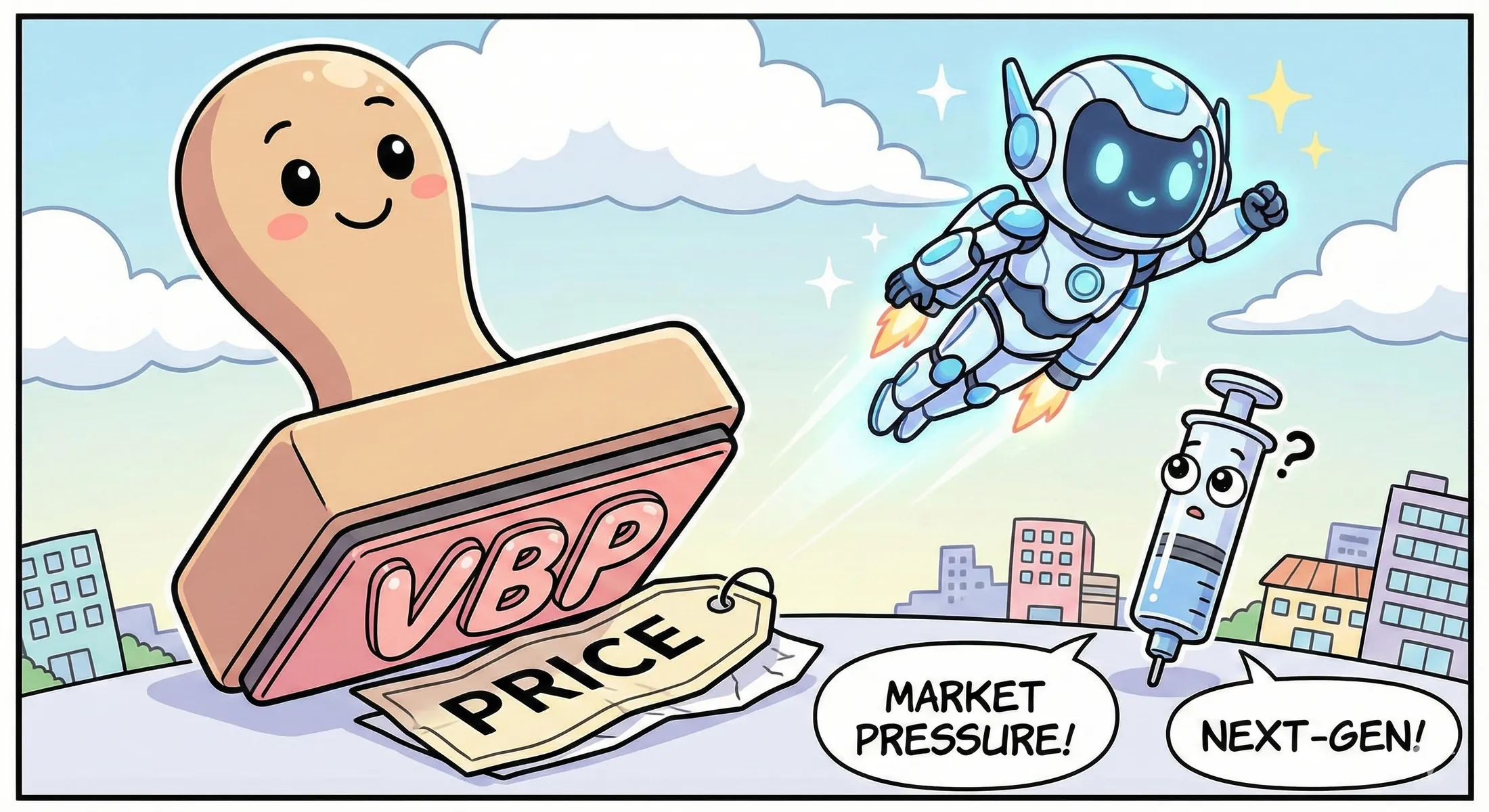
Once the top of the market moves, the pricing ladder below it compresses.
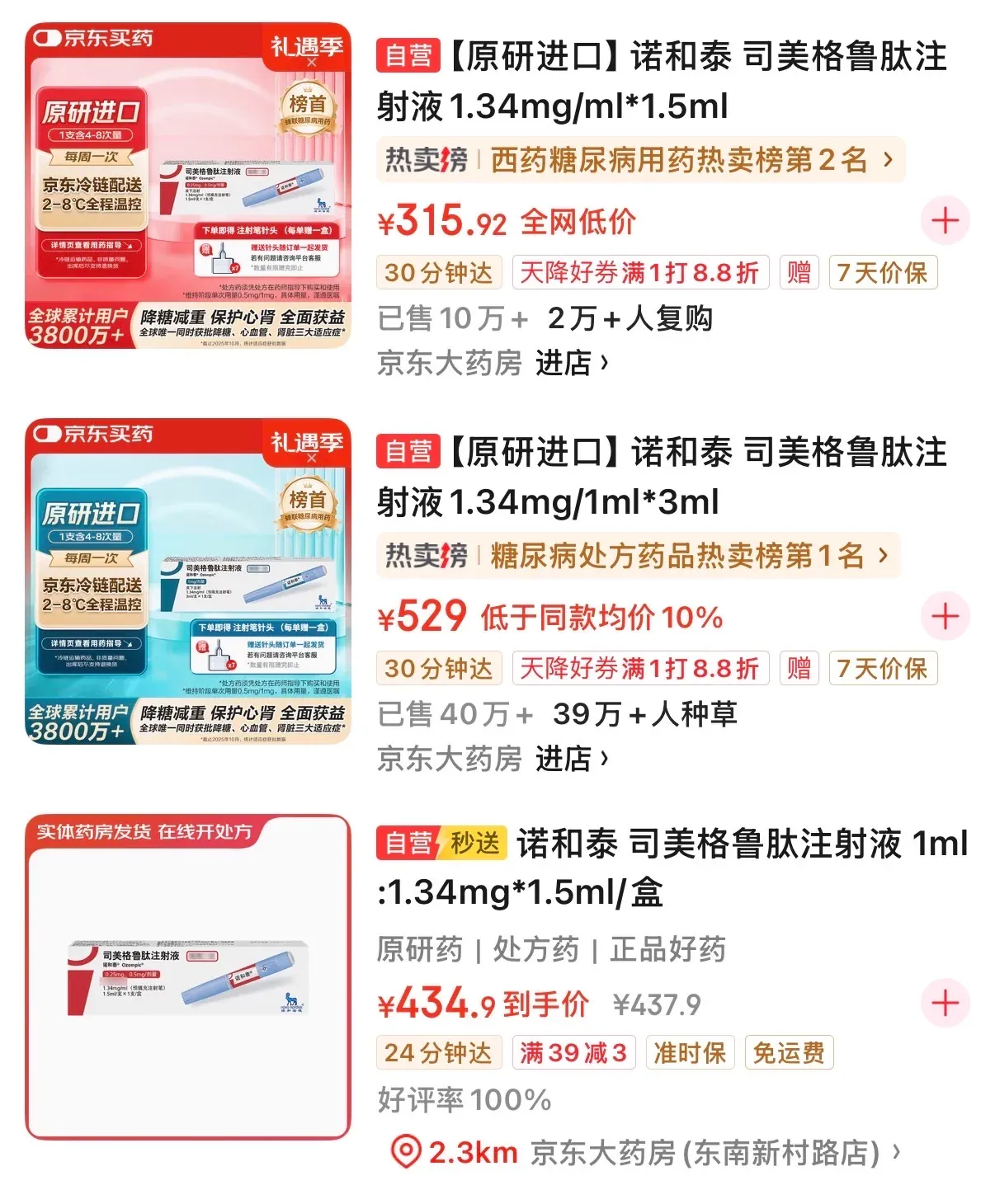
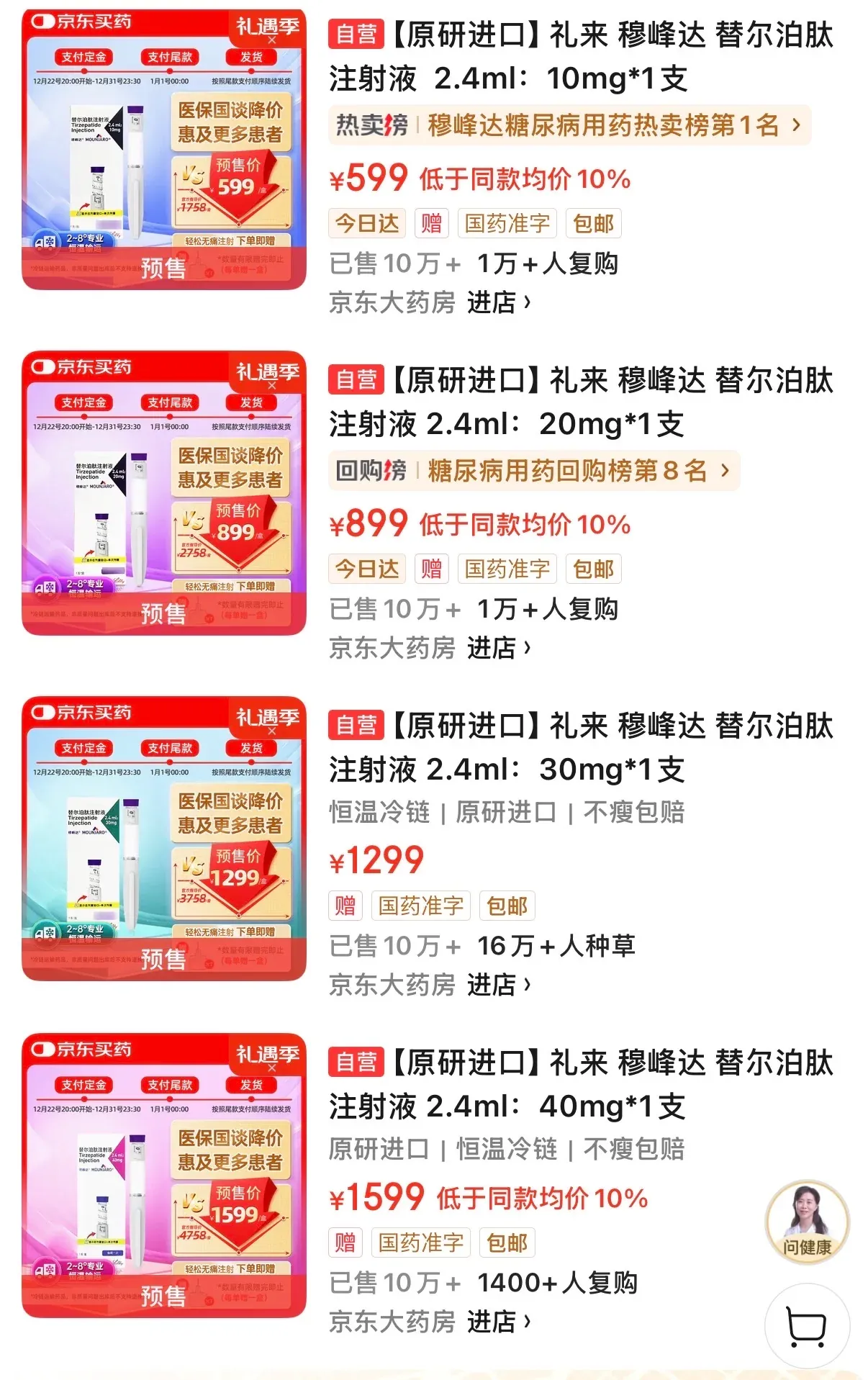
And you can already see the “ladder shape” in retail screenshots from JD Pharmacy: semaglutide listings clustered around RMB ~315–529, while tirzepatide listings are higher (roughly RMB ~599–1599), depending on strength and listing: the screenshots below are representative.
Bottom line: not milk‑tea cheap, but a steep drop is plausible by ~2027
My forecast is simple:
Semaglutide in China is unlikely to collapse into single‑digit yuan pricing, because injection pens and sterile fill‑finish impose a physical cost floor that vaccines and tablets don’t share.
But a China‑style price war is still very plausible, because the supply side is getting crowded fast, procurement mechanisms reward interchangeability, and better next‑gen drugs are moving the top of the market upward—turning semaglutide into the “good enough” tier that competes on value.
If those forces play out on a normal China timeline, sub‑RMB 100 per pen for domestic semaglutide (especially biosimilars) looks plausible around 2027. Not “cabbage price” in absolute terms, but close enough to feel like a reset.
And once semaglutide establishes a lower reference price, it will also pressure newer GLP‑1s. They may keep a premium for better outcomes, but premiums are always negotiated relative to the closest “good enough” alternative.