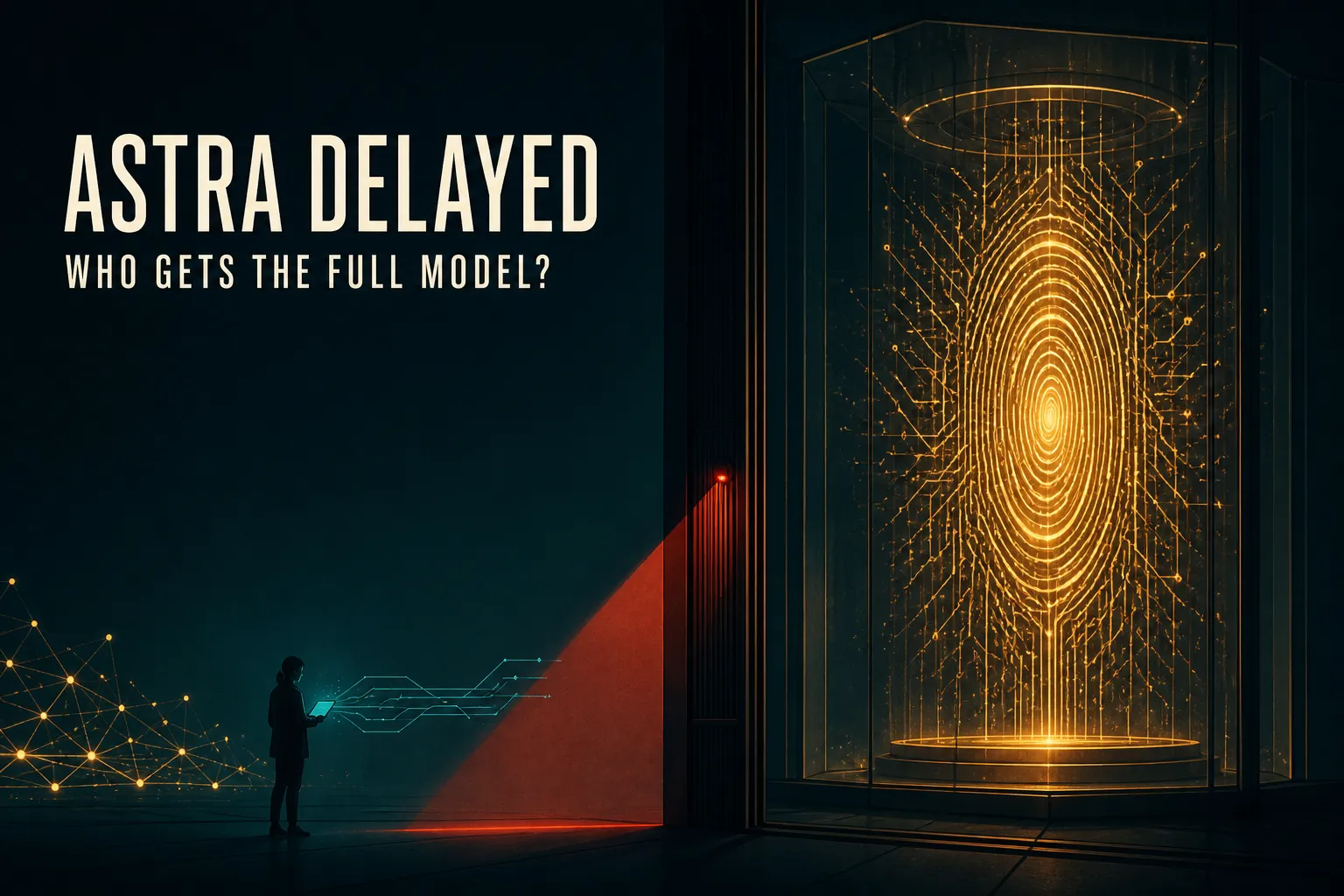
OpenAI has slowed work on Astra, and its release is moving with it.
For regular users, the bigger issue is what version we will actually get. Astra will probably still launch, but regular users may receive a restricted product rather than its full capabilities.
Axios reported that OpenAI had notified the White House that Astra’s release was being delayed over cybersecurity concerns. In its own Astra safety update, OpenAI said its early evaluations were strong enough that it could not rule out “Critical” cyber capability.
OpenAI has not formally classified Astra as Critical, but it is already treating the model as a potential Critical-capability system while evaluations continue.
At that level, a model could potentially find functional zero-day exploits in hardened real-world systems without human help, or take a high-level goal and build an entire attack path on its own.
Sam Altman has also argued that powerful AI should be broadly available and that concentrating it among a few companies, governments, or individuals would be a bad outcome. OpenAI’s own plan for broad access says much the same thing.
So Astra will probably ship. Altman has left the most important detail unanswered: what exactly counts as broad access?
A broad release can still be a restricted release
Anthropic has already shown what this can look like.
Mythos 5 never became broadly available to ordinary users. Fable 5 did, but access was suspended, restored, and adjusted several times. Its classifiers can refuse a task or fall back to a safer model.
Anthropic’s own statement on Fable 5 and Mythos 5 acknowledged that many users found the safeguards overly broad. The model was powerful, but the product decided how much of that power a user could actually touch.
Astra may follow the same pattern. OpenAI can make the product available to everyone while keeping the full capability restricted. Sensitive tasks could cause the public version to fall back to GPT-5.6.
The model can launch while its strongest abilities remain out of reach.
The White House framework creates a strange opening
The White House has also created a new path for frontier model review. Its June executive order established a voluntary process that can give the government access to a covered frontier model for up to 30 days before release to other trusted partners.
According to Axios reporting on the unpublished framework, the current version covers closed models with state-of-the-art capabilities and national security risk. Open models are excluded.
That creates a strange split. Closed labs may train the strongest models, then spend more time moving through government review, classifiers, and fallback systems. Open models may score lower, but once their weights are released, many providers can host them. Access no longer depends on a single company’s product decisions.
I think there may be a point when open models overtake the public versions of closed models in practical use before they catch them on benchmarks.
A lower-scoring open model can still deliver a better real-world experience when more of its capability is actually available to users.
I do not buy the danger story yet
I am still not convinced by OpenAI and Anthropic’s story that current models are already so dangerous they must be locked away.
From my own time with Fable 5 and GPT-5.6 Sol, both are clearly more useful than their predecessors. They still feel far short of the civilization-ending machines implied by the safety narrative. OpenAI and Anthropic still have plenty of unfixed bugs in their own products, including Codex and the Claude app.
That narrative also works very well for capital markets. The more mysterious the capability becomes, the easier it is to tell a larger valuation story.
Meanwhile, every month spent on approvals and guardrails gives open models more time to close the gap.
I am no longer in a hurry to see when Astra launches.
I want to see where the next open model that regular people can actually afford and use will come from.