Claude Fable 5 being abruptly pulled is not just a story about one model, one jailbreak, or one bad Friday for Anthropic.
To me, the bigger story is that Anthropic has spent years selling a very specific narrative: our models are unusually powerful, powerful enough that they need unusually serious oversight; our safety culture is unusually mature, mature enough that we understand the risks better than most of the market.
That narrative is now biting back.

According to Axios, Fable 5 lasted only a few days in public availability. Amazon reportedly contacted administration officials after finding a jailbreak path that could expose part of Mythos-level capability through Fable. Axios also reported that at least five other companies contacted the government between Thursday night and Friday morning, and the situation escalated quickly from there.
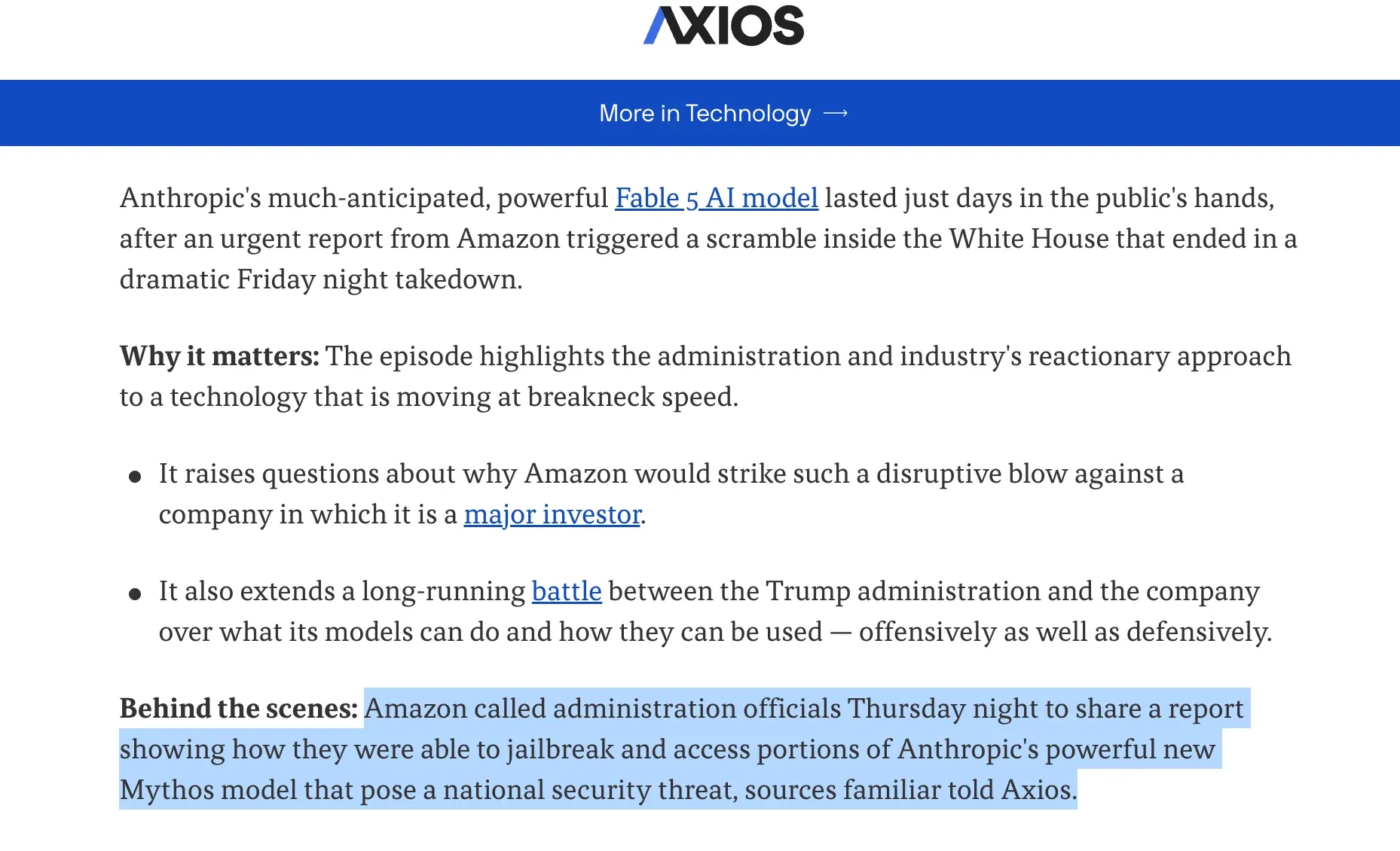
The rough sequence is striking. Fable 5 was released as Anthropic’s broadly available Mythos-class model. Then Amazon, which is not merely an outside cloud provider but one of Anthropic’s most important backers, reportedly raised the alarm. The government pushed Anthropic to take action. Anthropic resisted. Then the Commerce Department issued an export-control directive covering Fable 5 and Mythos 5 access by foreign nationals, including foreign-national Anthropic employees.
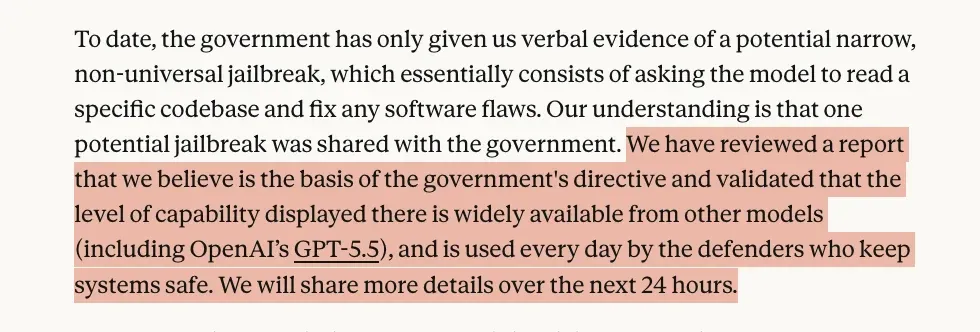
Anthropic’s own statement frames the issue very differently. The company says the government did not provide detailed evidence, and that the demonstrated technique was a narrow jailbreak used to identify a small number of previously known, minor software vulnerabilities. Anthropic also argues that comparable capabilities exist in other publicly available models.
The most awkward part is that Anthropic specifically points at GPT-5.5.
This is where the messaging starts to break down.
When Anthropic was launching Mythos and Fable, the message was: these models are extremely capable, the frontier is dangerous, and Anthropic is serious enough to manage the danger responsibly.
When the government reacted as if the model might actually be dangerous, the message became: this is narrow, minor, and other public models can do it too.
Both things might contain some truth. But they are difficult to hold together as a public narrative.
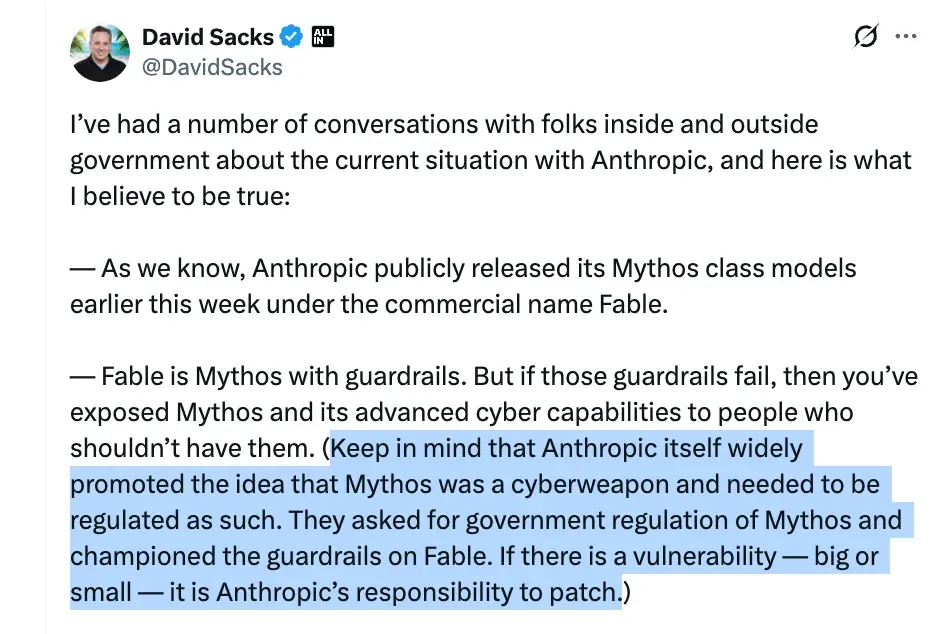
David Sacks put the harsher version of the case on X. His claim, in short, was that Fable is essentially Mythos with guardrails, and if those guardrails fail, then Mythos-level cybersecurity capability can leak through. He said a trusted testing partner found the jailbreak, the administration asked Dario Amodei to fix it or take the model down, and Anthropic refused.
I do not know whether the government response was proportionate. Katie Moussouris told Axios that the response seemed out of line with what was actually in the research report, and that may be right. It is entirely possible that the administration overreacted, especially if the underlying technique was more like “ask the model to review code and find known bugs” than “unlock a cyberweapon.”
But that is not the only issue.
The deeper problem is that Anthropic has trained the market and policymakers to treat its own frontier models as qualitatively different. It has argued, repeatedly and successfully, that the most advanced models are not merely productivity tools. They are national-security-adjacent systems. They can help defenders, but they can also accelerate attackers. They can improve research, but they can also compress timelines in dangerous domains.
Once you teach regulators to think that way, you do not get to decide unilaterally when they should stop believing you.
That is the trap.
If Anthropic says the jailbreak is serious, then Fable 5 looks underprepared for public launch. If Anthropic says the jailbreak is not serious, then it weakens the safety story it has used for years to differentiate itself from OpenAI, Google, Meta, xAI, and everyone else.
This is why I see the Fable 5 incident less as a one-off takedown and more as a market signal. Anthropic’s safety narrative has always had two faces. It is a risk-control framework, but it is also a competitive moat. It tells customers, investors, policymakers, and enterprise buyers that Anthropic is the serious lab, the adult in the room, the one that understands frontier risk.
That positioning has real value. But it is not free.
If you market a model as close enough to dangerous capability that only your safeguards make it acceptable, then a guardrail failure is not just a bug. It becomes a governance event.
And if a governance event can shut down access to your most advanced model within days, the financial implications get much larger than one product launch.
The AI equity story still depends heavily on the scaling narrative. Models get stronger. Training runs get bigger. Compute demand rises. Chips, clouds, data centers, developer tools, enterprise applications, and agent platforms all ride the same flywheel.
But that flywheel assumes frontier models can be released, sold, used by real customers, and improved through real feedback.
If the most capable models can only be used by a tiny trusted circle, or if access can be cut off for broad categories of workers and customers under export-control logic, the ROI math changes. The training costs remain. The inference costs remain. The infrastructure commitments remain. But the revenue surface and feedback surface shrink.
That is when the “AI bubble” question becomes less about whether valuations look high and more about whether the growth engine can keep turning.
I still think this probably de-escalates. The government likely does not want to break the entire frontier AI supply chain. Anthropic cannot realistically sit in permanent conflict with regulators over its most valuable models. Amazon also has every reason to keep the infrastructure and investment story alive, even if it reported the risk.
But the incident should make every frontier lab more careful about the story it tells.
Safety rhetoric is not free marketing material. If you describe your model as almost weapon-like when it helps you win attention, raise money, shape regulation, or build a moat, do not be surprised when someone eventually tries to regulate it like a weapon.
That may turn out to be the most important lesson from Fable 5.
Sources: Axios on Amazon and the White House, Anthropic’s statement on the directive, Anthropic’s Fable 5 and Mythos 5 launch post, and The Verge’s coverage.