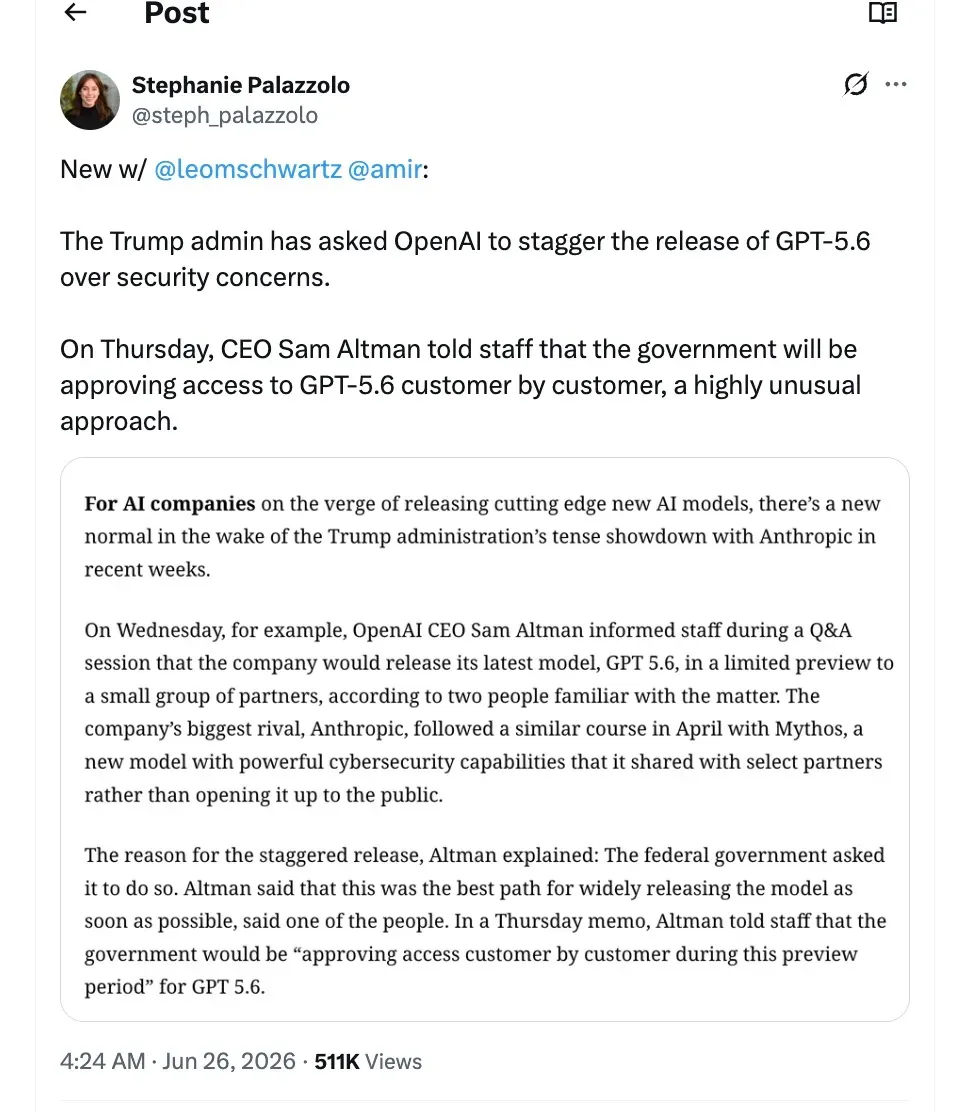
The Information is reporting exclusively that the Trump administration asked OpenAI to stagger the release of GPT-5.6.
Specifically, CEO Sam Altman told staff during a Wednesday internal Q&A that GPT-5.6 would ship as a limited preview to a small group of partners — because the federal government asked OpenAI to do so. On Thursday, Altman followed up in an internal memo: during the preview period, the government would be approving access to GPT-5.6 customer by customer.
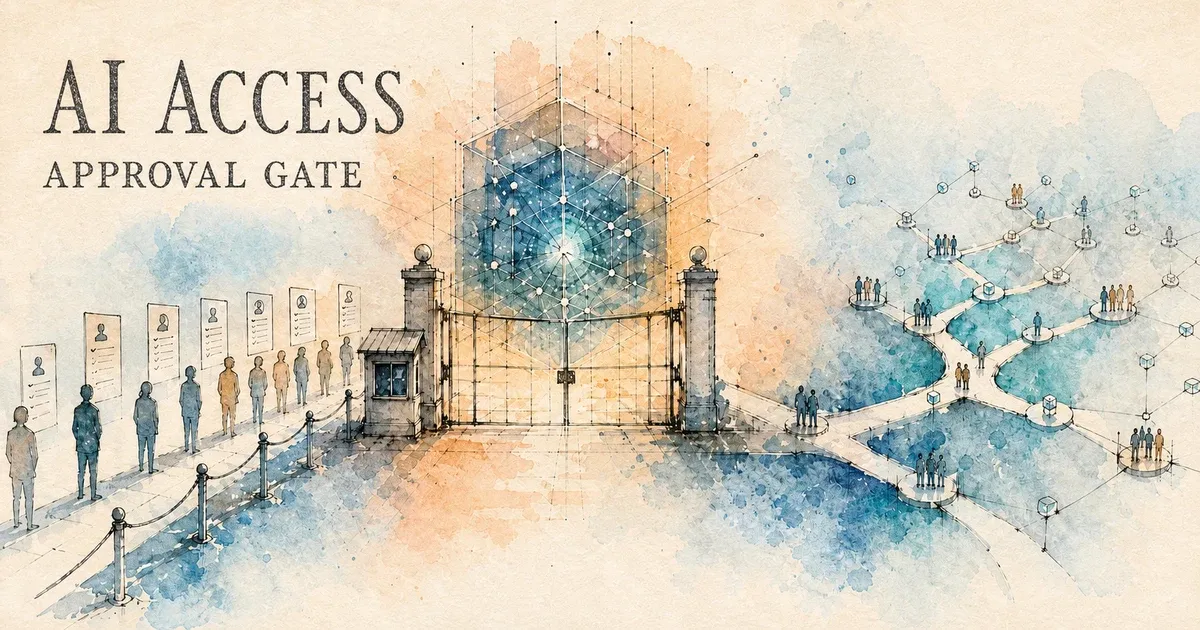
That means it is no longer pay-and-play. The government decides who gets access.
Anthropic took a similar route in April when it released Mythos, restricting its cybersecurity-capable model to selected partners only. But that was a specialized security tool. GPT-5.6 is a general-purpose model — and even it now requires an approval process. That is a qualitatively different move.
I think this may be a turning point.
The strongest models are no longer open shelf
Looking ahead, the most capable models will no longer be something you can just buy. The old logic was straightforward: pay for a subscription, maybe pick between a free tier and a Pro tier, and you are in. Now the question is whether you are cleared to use the model at all — and the government makes that call.
The policy sounds like it is protecting national security. But flip it around: it will inevitably compress the addressable market for frontier model companies.
Approved enterprise clients may pay a higher per-seat price, but that does not mean commercialization gets easier. The companies that clear a government review are most likely large corporations, not small or mid-size businesses. These clients are few in number, and their internal adoption will be cautious — layer after layer of compliance, security review, and procurement. They will not experiment the way an indie developer community does, rapidly integrating models into automated workflows through trial and error.
This is already playing out. Anthropic spent months trying to break into Goldman Sachs, sending engineers on-site, and is still constrained by compliance requirements. Its Hong Kong employees cannot even access the product.
More importantly, the capabilities that make GPT-5.6 and Mythos worth controlling — cyber, coding, and complex task execution — are not capabilities that every industry can immediately convert into high-value replacement. Pharma, finance, and manufacturing can certainly use these models for research and analysis, but assistance is not replacement, and assistance alone does not easily prove high ROI. When ROI looks weak, downstream funding and R&D investment contract accordingly.
There is also a practical execution problem. The point of per-customer approval is to keep the model away from untrusted actors. But people change jobs. Partners rotate staff. A single employee departure can trigger a re-review. The institutional cost of maintaining this approval regime at scale will be enormous, and I am skeptical it can hold up over time.
An unexpected window for open-source
If the strongest proprietary models are locked behind an approval wall, what will ordinary developers and small businesses do?
The answer is obvious: they will turn to open-source.
If America’s frontier models are only available to government-approved customers, those models lose something critical: large-scale community feedback. The more people use a model, the more bugs get reported, the more edge cases get tested, and the faster it iterates. Closed-door development is one thing; whether you have millions of real users stress-testing your model is another.
For open-source models — including Chinese ones like DeepSeek and GLM — this could be an unexpected gift. If they keep absorbing the community-scale feedback loop that proprietary models are now walling off, their development trajectory could end up healthier than the controlled-access frontier models.
But do current models really warrant this level of control?
Honestly, I think LLMs are being treated as more dangerous than they currently are.
Coding is the one area where the progress is real and substantial — I will give it that. But outside of writing code, the actual high-value applications of general-purpose models are still limited.
In financial analysis, medical research, and other domains that would justify serious concern, these models assist. They do not replace. I have yet to see a single investment bank fire its analysts and replace them with GPT. Even for simpler roles like sales, aside from some social media operations, models cannot do the job end to end.
So is per-customer government approval premature? I think so.
When models can genuinely perform full replacement in critical domains, controls will make sense. But at this stage, the policy looks like it is solving a problem that does not yet exist — while creating a real one: throttling the commercialization speed and R&D feedback loop of frontier models.
If this policy persists long-term, the biggest beneficiary may not be American national security. It may be America’s competitors.
That said, I am not sure how long this regime will last. Altman himself said he hopes to open access more broadly “in a few weeks.” Maybe this is just a transitional phase. But even as a transition, the signal is clear: frontier AI models are moving from commercial products to regulated goods.
Going forward, using the best model may require more than a credit card. It may require clearance.