SentenceDeck 1.5 was built around one loop: hear a sentence, say it, and play yourself back while the sound is still fresh. It works well for an article or a script you already have. But most of the speaking people actually need to do is not reading. It is answering someone: the agent at the check-in desk, the landlord on the phone, the colleague who asks how the weekend was.
Version 2.0 keeps the loop and puts it inside a conversation. Pick an everyday scene, choose your level, and practice your side of a short dialogue with a partner voice, one line at a time.
Thirty scenes, three levels
Scene Dialogues starts with a library of 30 everyday scenes in five categories: Travel, Daily Life, Work, Social, and Emergencies. You choose a level (A2, B1, or B2), and AI writes a short dialogue for that level, with a translation under each line in your interface language.
Twenty-one of the English scenes come built in at B1, with their audio included. They work offline and cost nothing, so you can start on a plane.
New dialogues come in two options. Standard is free, up to 10 a day. Detailed writes a fuller dialogue and uses 200 characters; the cost is shown before you start, and nothing is charged if generation fails or the same dialogue is returned from the cache.
<video class=“mx-auto mt-8 w-full max-w-xs rounded-3xl” src=“/products/sentencedeck/v2.0/sentencedeck-2-0-preview.mp4” poster=“/products/sentencedeck/v2.0/sentencedeck-2-0-preview-poster.webp” width=“444” height=“962” autoplay muted loop playsinline aria-label=“SentenceDeck 2.0 screen recording: the sketchbook title screen with three tickets, then the intro pages for listening and speaking, playing either side, everyday scenes, describing your own scene, Read Along, and passport stamps”
Listen, speak, hear yourself
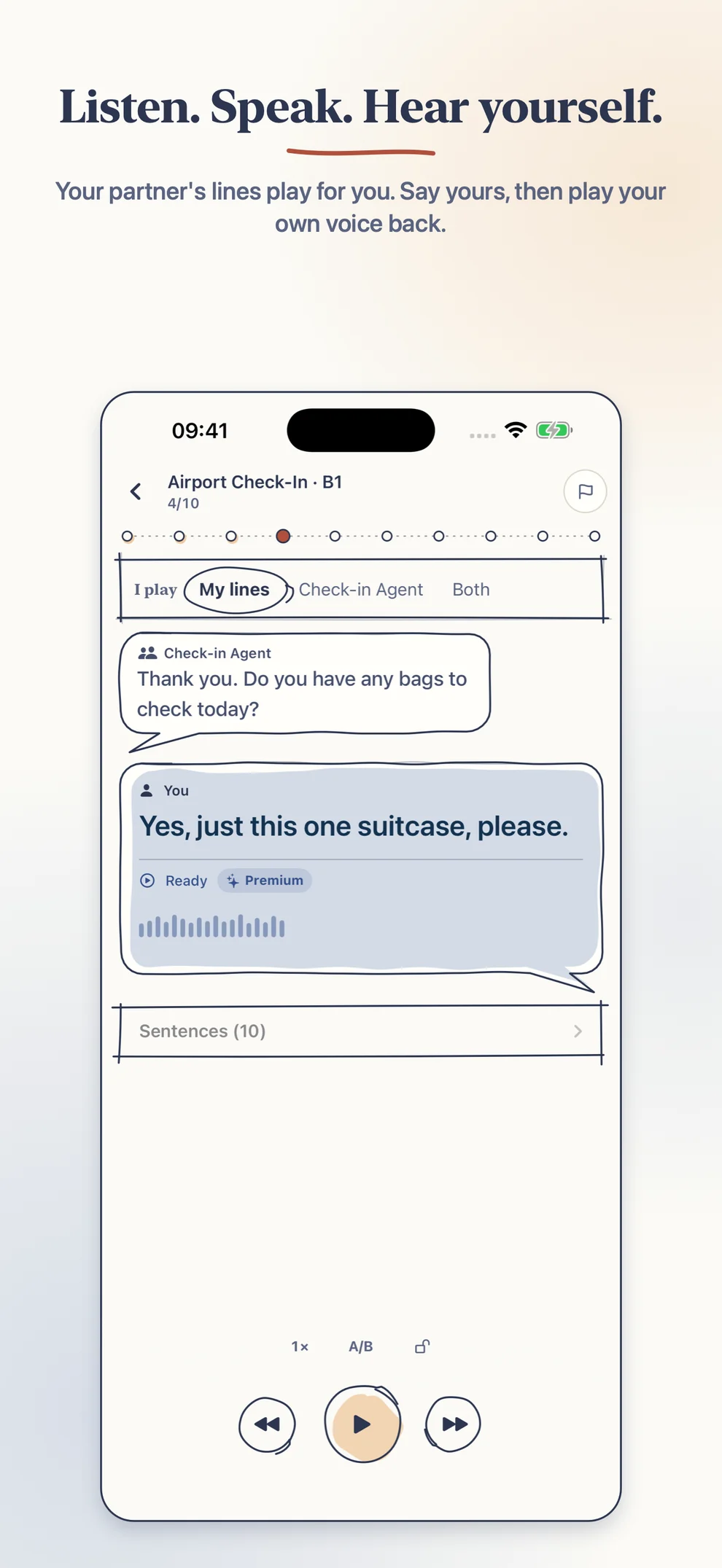
On the stage, your partner’s line plays first. Then it is your turn: you say your line, recording stops on its own when you finish, and you hear yourself straight back. You can practice only your own lines, swap roles and take the other side, or practice both. A/B compare, sentence lock, and playback speed from 0.75× to 1.5× all work here, the same as in Read Along.
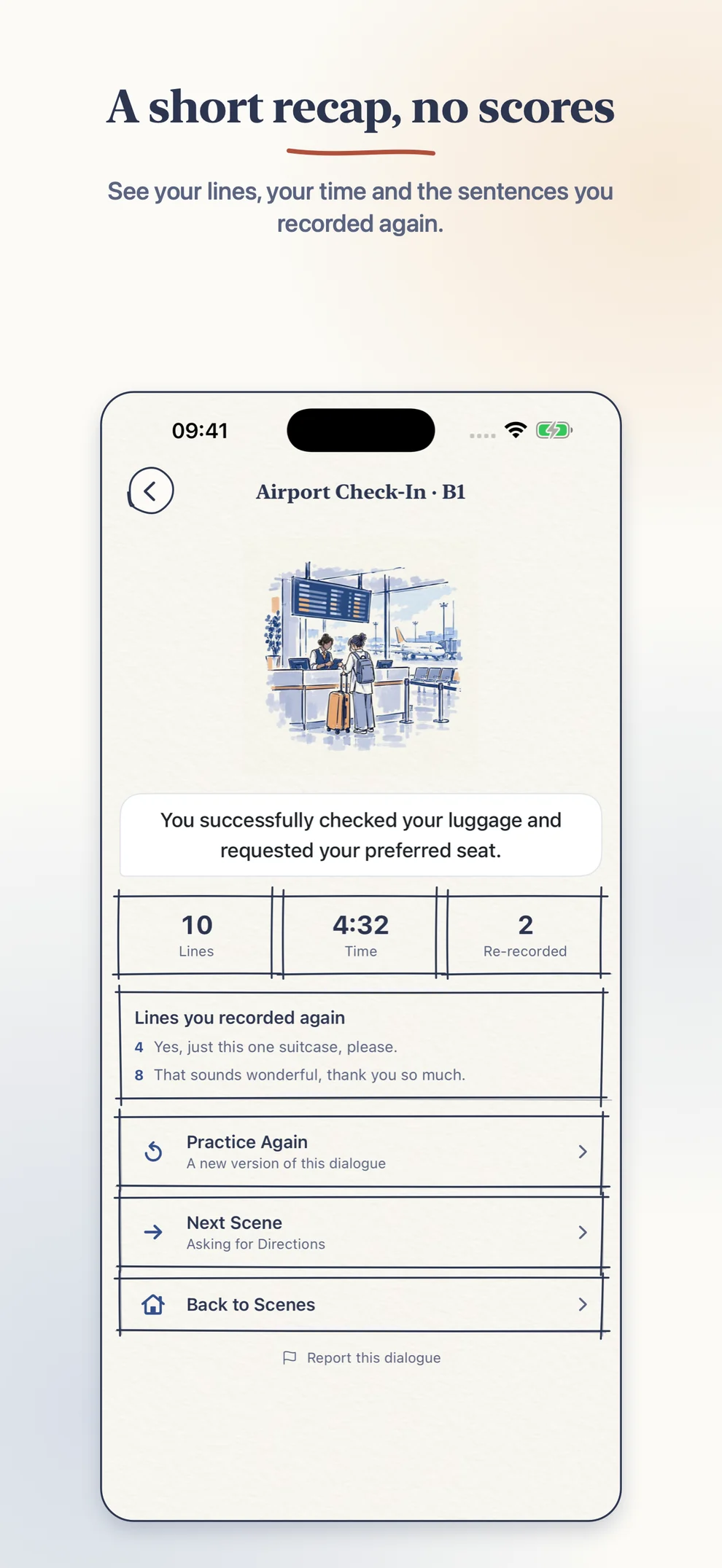
When you finish a scene, a short recap shows how many lines you practiced, how long it took, and which lines you recorded again. That is all it shows. There are no scores, grades, corrections, or rankings in SentenceDeck. You are the one who decides whether the second take sounded better.
Each finished scene also earns a stamp in My Passport, next to today’s lines, your day streak, and your total. My Scenes keeps every dialogue you have practiced, with all of its versions, and it is searchable.
Describe your own scene
The library will never have every situation. So the second ticket on the title screen lets you describe one in a sentence (up to 200 characters), such as calling your landlord because the water heater is broken, and SentenceDeck writes a dialogue for it at your level.
Custom scenes are for everyday situations. The first time, SentenceDeck asks before sending anything: your description goes through our server to Google Cloud’s AI service, it is not stored, and you can withdraw your agreement later in Settings. Please leave out names and contact details; descriptions with web addresses, email addresses, or phone numbers are refused before they reach the AI service. If any AI-written dialogue comes out wrong or odd, you can report it from the stage or from the recap.
Read Along, and the voices
The third ticket, Read Along, is the 1.5 practice loop: paste or import any text, and practice it sentence by sentence.
System voice is still free, offline, and unlimited. Premium voice sounds more natural and now speaks scene lines in the mood of the scene. It uses characters once, when a sentence is first generated, and the saved audio replays for free. In a dialogue you can pick a voice for each side and play free samples before you decide. Character packs come in 6,000, 30,000, and 72,000 characters, and they never expire. There is no subscription and no account.
A sketchbook
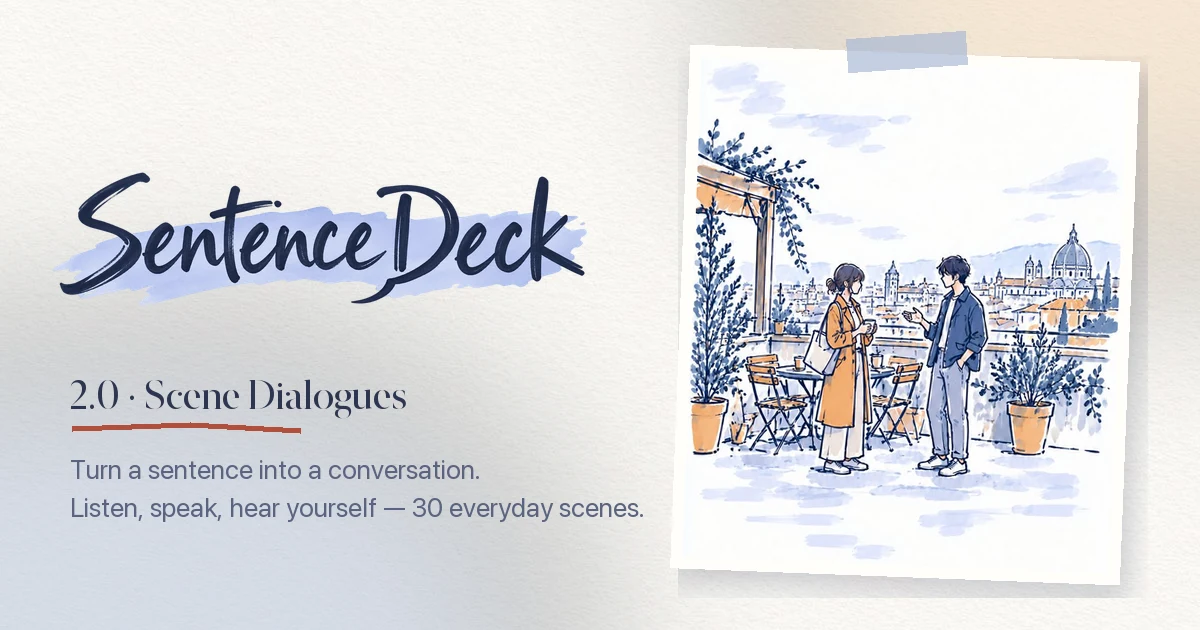
The whole app is redrawn by hand: watercolor scenes, ink lines, tape on the corners, and a night sketchbook in Dark Mode. It runs on iPhone and iPad, and the interface is available in 10 languages. A short animated intro walks through everything on first launch, and you can replay it from Settings → Replay Intro.
Backup & Export is now Backup & Restore, and it keeps your generated audio, so you can move your scenes and articles to a new device without generating anything again.
What did not change
Your recordings stay on your device. There are still no ads, no tracking, no subscription, and no sign-up. The full details of what is sent where are in the privacy policy.